| I | D | E | E | S |
Follow us 

|
CAT ESP |

Over half of people under 29, both men and women, have individual income levels below the poverty line, making it impossible for them to live alone (set up a single-person household) with a minimum level of well-being. From age 30 onwards, however, the gender gap widens. Furthermore, as people get older, women are more likely to have insufficient income to live independently, while the reverse is true for men: the older they are, the more likely they are to have sufficient income to live alone. Although most homes are not single-person households, the most common being that of an adult…

Employment segregation is considered to exist when the distribution of men and women in specific economic sectors is not balanced. Looking at employment fields with the greatest weight (such as health, construction and education), as well as those of major structural importance (ICT, agriculture and the domestic sector), we find gender segregation in many cases. Construction, the primary sector, and ICT are 75% male, while women predominate in similar proportions in the domestic and heath sectors. In general, horizontal employment segregation means women are concentrated in lower paid sectors and in those which society values less. The sectors where women…

Marriages between men and women account for 96.5% of the total, with the remaining 3.5% being same-sex marriages (507 between men and 523 between women in 2017). The opposite-sex marriage rate fell in recent years, with a sharp drop following the start of the recession in 2009. The rate has recovered slightly since 2014. Marriages between men took off in the first years after legalisation (2005 and 2006), but then dropped over the following decade until 2015, when the numbers began to go up again. Marriages between women, however, seem to be less linked to the economic climate, increasing gradually…

Over the last decade, the average age at which women give birth to their first child has been constantly rising, as has the average age of motherhood (the average age at which women have any of their children, whether the first or not). In 2007, women became mothers at 29.3 years old, on average, now the average is 31 years. This trend, seen throughout the European Union, set alarm bells ringing, calling for an examination of the economic and material conditions faced by women of child-rearing age, the sharing of responsibilities in the home and the support provided by governments…

Women’s representation was a key issue on the political agenda in the most recent local elections. As a result of the elections, women now head the governments of some of Catalonia’s biggest cities, including Barcelona. The number of women councillors has also increased everywhere. Despite this positive trend towards pluralism in the exercise of key public roles, the situation is still far from ideal: in 393 municipalities, i.e., four in ten, men account for more than 60% of town councillors, going against the spirit of the current law.

Although much is said about gender imbalances in the fields of political and institutional power, it is in the area of economic power where inequality is most extreme. This is clear from the fact that the chairmanship and most senior executive posts (CEO) in the main listed companies are overwhelmingly held by men: 93% of European companies and 97% of Spanish companies.
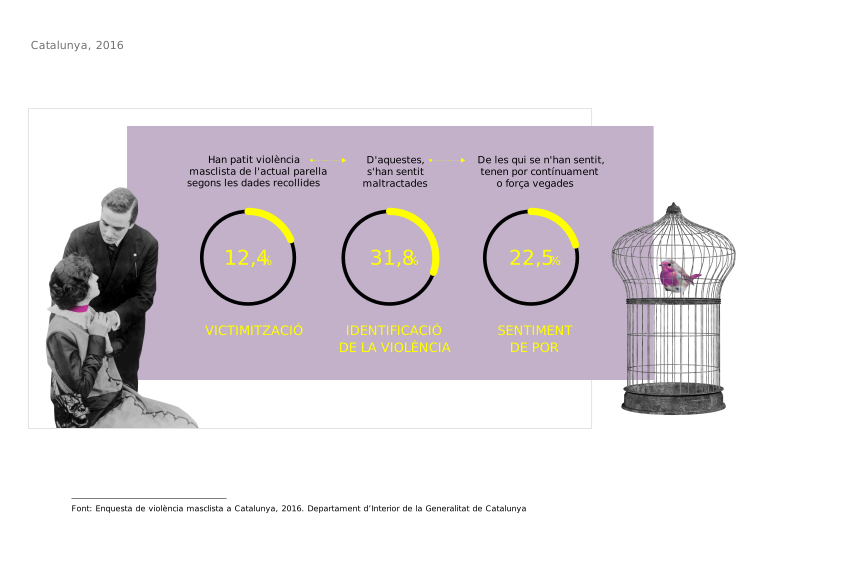
If you are part of a couple, it is hard to recognise, or even realise, that you are suffering from gender violence inflicted by your partner. For this reason, the gender violence survey included questions on a range of situations, leading to the conclusion that 12.4% of women over the age of 15 in Catalonia had been the victims of gender violence at the hands of their current partners. Of these, only one third recognised that they had been abused. Of those that recognise the abuse, one in five state that they are often or always afraid of their partner.…
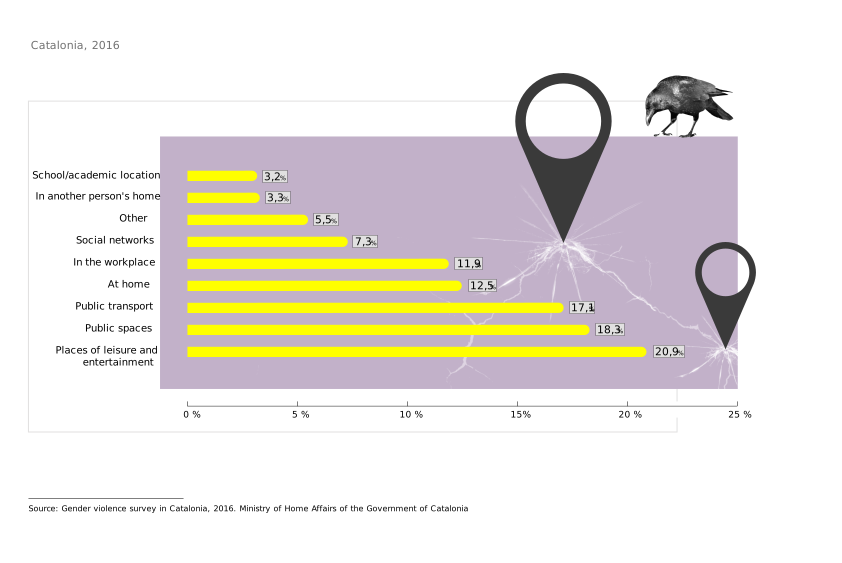
Half of all women, in particular young women, state that they have been the victim of sexual aggression, including obscene comments, exhibitionism, touching, harassment and rape. The majority of perpetrators are men who are not the woman’s partner or ex-partner. To tackle this, it is useful to know where such aggression commonly takes place. The last Gender violence survey revealed that public spaces, such as streets and squares, and, above all, places of leisure and entertainment, are the most common locations for sexual assaults. The workplace and academic spaces also feature, despite the existence for many years of protocols and…

Cultural habits, how people inform themselves and leisure activities vary between genders. With regard to reading, women read more books and magazines, while men more frequently read newspapers. Listening to the radio and playing video games are more male activities, as are listening to music and using the Internet, although both sexes frequently engage in these activities. Going to concerts, the cinema and the theatre are less common activities for both sexes to more or less the same extent. However one activity unarguably stands out above all others, with no significant difference between the sexes: watching television.

The visibility of artistic and creative men and women in cultural spaces varies significantly depending on the type of space: a large auditorium is not the same as a civic centre. In Barcelona, where it has been possible to identify these differences, there is a clear hierarchy: women are most represented in the least prestigious spaces, with the lowest funding and those most related to everyday life, such as civic centres and libraries. Meanwhile, men overwhelmingly dominate in the most prestigious and best financed venues, such as large auditoria and theatres. For more information on the lack of visibility of…

Women’s presence and working conditions in the world of film have been one of the most controversial issues in recent years. Men and women’s consumption of film and academic interest in the cinema are the same, but women have lower levels of employment and recognition in the industry, although this has improved substantially in recent years. In the 2017-2018 academic year, 465 women and 428 men studied film or audiovisuals in the Catalan university system. There is a talent drain, however, when these skills are transferred to the world of work, as shown by the latest employment figures for the…

Instead of opening up new scenarios, all too often a question prefigures an answer and further narrows the pre-existing territory: we learn little in this way. If we really want to challenge ourselves, a question will lead us to another question and this map of possible answers will show us the extent of our ignorance: this is how we learn, from knowing in depth what we do not know. When we think about the future of Europe —when we ask ourselves about the future of Europe—, it is essential to analyse in depth the initial conditions, that is, to x-ray…

In a mountain village in Europe in the spiritual back of beyond when icy winter arrives it’s time to slaughter the pig up there in a world of their own locals gather in the street they’re not from Porto or Geneva Madrid or Bucharest they can’t make head nor tail of European Parliament debates to them the whole business all sounds like hogwash they don’t know the far right has the run of the place Brexit’s set the cat among the pigeons even if they knew all this they couldn’t do a thing about it governments and people out of step like odd socks in today’s Europe always wrong-footed, staggering from one disaster to the next but they can’t escape the telly after picking the crops and checking the chickens are safe from the fox they spend their evenings on the sofa watching whatever they find on the box it’s always the same old rubbish ranting and raving on every channel …

Kate Tempest (2017) Europe Is Lost, Let Them Eat Chaos. Londres: Fiction Records In the basement flat, by the garages Where people dump their mattresses Esther’s in her kitchen, making sandwiches The slats on her blinds are all wonky and skewed You can see her from the street before she moves out of view To kick her boots off tired feet She wipes her forehead with her wrist She’s just back from a double shift Esther’s a carer, doing nights Behind her, on the kitchen wall Is a black and white picture of swallows in flight Her eyes are sore, her muscles ache She cracks a beer and swigs it She holds it to her…

Guai no ho era, perquè jo era petita i encara no estava socialitzada amb el codi del que molava i el que no molava, però sí que tenia una vaga idea de què era i què no era modern. I modern era veure una sèrie de televisió que semblava una sèrie de dibuixos animats pels colors brillants que tenia i per com d’histriònics eren els actors. De fet, la caràtula i els crèdits de la sèrie eren animacions i, probablement, per això em vaig enganxar a un producte televisiu pensat estrictament per a adults, perquè es cagava en tot allò que a…

According to Chantal Mouffe, currently prevailing political theory is incapable of conceiving a form of democratic politics appropriate for this post-Cold War age of globalisation. For this reason, she believes we must develop and define the basic principles of a new model called “agnostic pluralism”. In the final part of the article, the author presents some reflections on the type of progressive politics she considers most capable of strengthening democratic citizenship in the current age of globalisation. This article forms part of issue 37 of the IDEES magazine, “Democracy is deciding”, published in print format in the January/April 2013 edition.…
In this article, Paul Ricoeur carries out a critical re-reading of his last book, a re-reading that stems from a new viewpoint: in agreement with the lexical definition of history as historiography, he uses writing as a central pillar for historical analysis before moving on to a hermeneutical analysis of reading or, from a broader perspective, the reception of literary accounts of history, both public and private. This article forms part of issue 28-29 of the IDEES magazine, “Memory, history and identity”, published in print format between January and June 2006. The PDF article is available to download in Catalan…

IDEES is embarking on a new phase of its life as a magazine, adopting a new editorial approach that focuses on monographically analysing the major issues currently being debated on the global level. After more than twenty years and forty-five issues, IDEES is making the transition from print to digital, moving forward with a fresh image and design to take an in-depth look at today’s world from new standpoints and perspectives. Publishing a magazine on contemporary thought, particularly from within the Government of Catalonia, is no simple task and might be described as something of a fool’s errand. This is…

The debate on mobility today revolves around goals, instruments and results that countries of origin, destination and transit coordinate in relation to the phenomenon. Thus, it is a public policy debate that is essential to every state, as it affects key constitutive elements such as territory and population. Furthermore, in the case of European immigration and asylum policy, it also affects the concept of sovereignty, as such policy can only be constructed through the converging wills of European Union Member States. The aim of this article is to examine some of the most pressing issues in European immigration and asylum…

“Every day, young people arrive in African cities. They have abandoned school and the family home to try and enter the modern world. A youth stuck between tradition and modernity, between Islam and alcohol… seduced by the modern idols of boxing and cinema” . Thus starts Moi, un noir (1958), an experimental film in which Jean Rouge shows the daily life and difficulties of Nigerien youths who have emigrated to Treichville, a suburb of the Ivory Coast capital, Abidjan. Fifty years later, Ousman Oumar, seduced by the aeroplanes piloted by whites over his Ghanaian village, decides to set out on the…

While the far-right demonizes the EU for its lack of borders and the resulting ‘barbarian’ invasion, with too many immigrants ‘stealing’ jobs from ‘nationals’ and threatening local culture, the radical left argues that the EU’s institutional architecture is neoliberal by design, always favoring the interests of big business or, more generally, the ‘market’. To this end, the EU has emptied the Member States of the competencies required to guarantee social welfare without developing them itself and has reinforced the role of states as instruments for containing and repressing social unrest. Hayek’s dream of the minimal state come true! However, if…

For liberals, the European Union is still a symbol of prosperity, security, and enlightenment. However, this view is no longer shared by the electorate in numerous countries. More and more voters are deserting pro-European parties and giving support to Eurosceptics. The fundamental question is: why is the EU no longer sexy? The European Union has lost its sex appeal for two fundamental reasons. First, it betrayed the liberal values upon which European integration was based. Second, it failed to adjust its institutions to the major geopolitical, geo-economic and technological developments, which have engulfed Europe over the past three decades. As…

Transcript of Salzburg Festival’s 2018 opening speech, exclusively offered by the author to IDEES magazine I I grew up as a child of the Enlightenment and was lucky enough to live in a house full of books. That fired up my imagination, albeit sometimes in quite unexpected ways. An example: like all fourteen-year-olds, I found life overwhelming and inexplicable, so I reached into the bookcase and found Immanuel Kant’s Critique of Pure Reason. I’d heard it was a great book and hoped philosophy would explain my life to me, in plain language and with rules. In a way, the whole thing…

After nearly a decade of stagnation, the euro area is finally experiencing a robust recovery. While this comes as a relief —particularly in countries with high debt and unemployment levels— it is also breeding complacency about the underlying state of the euro area. Maintaining the status quo or settling for marginal changes would be a serious mistake, however, because the currency union continues to suffer from critical weaknesses, including financial fragility, suboptimal conditions for long-term growth, and deep economic and political divisions. While these problems have many causes, a poorly designed fiscal and financial architecture is an important contributor to all…

Bellwether Transatlantic Moment Both the United States and Europe are at pivotal political and cultural moments, which will shape the course of transatlantic relations for years to come. European populations are both divided and unpredictable in their sentiments about the future of Europe and their relationship with the United States. In some ways, chaos seems to be the dominant theme; voters want change, but the form of that change varies widely. The U.S., on the other hand, is perhaps more divided than at any point since the Vietnam War and Watergate era, with political party lines continuing to harden. The…

‘Uncertainty is the only certainty there is, and knowing how to live with insecurity is the only security’ ― John Allen Paulos This is an era like no other. Once we were in a time when cooperation was driven by similarities in values and ideologies, but now, cooperation could be promoted by national interests which were carefully categorized. In the past 40 years, the cooperation between China and the EU experienced the peaks and troughs and either side has ever expected the complexity as it is today. The China-EU relations are at an intersection, facing the choices of cooperation, competition,…

The Brexit referendum was won on the slogan ‘taking back control’. The resonance of this slogan with British voters could be seen as confirming the longstanding complaint regarding the EU’s democratic deficit. Yet, shifting democratic authority away from National Parliaments to the European Parliament might likewise be seen as a loss of control so far as the various peoples or demoi of the member states are concerned. After all, similar reasoning has led national minorities within many of these states to voice demands for greater devolution of democratic authority and even secession. At the same time, in an interconnected world…

According to the latest United Nations figures, in 2017, the Member States of the European Union were home to 55.7 million people living outside of their birth country, which equalled 10.9% of the 511.8 million inhabitants of the EU as a whole at the time. Among them, 36.7% (20.4 million) were originally from another EU country, whilst the remaining 63.3%, or 35.3 million inhabitants, were from a non-EU country (see Map 1). In total, the EU was home to 20.3% of the world’s international immigrants. At the same time, 36.8 million people born in the EU were registered outside of…

On 5 October 2012, it was announced that the European Union had won the Nobel Peace Prize. This was recognition for a political project that arose after the Second World War. The war was the fifth military confrontation between France and Germany in the previous 150 years and led to the death of 70 million people. A solution had to be found, one that was European and political. Through economic cooperation, European construction forged bonds that were strong enough to incentivise member countries to resolve conflicts peacefully rather than through war. Thus the Noble Prize was awarded to a territory…

‘By 2025 we need a fully-fledged European Defence Union. We need it. And NATO wants it’ State of the Union Speech by the President of the European Commission13 September 2017 Challenges to security require awareness among European society of a reality already augured by multiple threats, such as international terrorism, pandemics, cyberwar, climate change, and external interference. A common denominator to all these threats is the complexity of the phenomena driving them, clearly complicating how States can tackle them. Indeed, dealing with these challenges requires, first of all, rethinking the traditional legal frameworks used to date and, secondly, promoting strong…